Wednesday, December 20, 2017

Core Rule Set: The evolution of an OWASP Project

https://coreruleset.org/poster/
Let me put one thing straight: there are two things when we talk about ModSecurity. There is the naked ModSecurity engine running inside NGINX or Apache and there is the rule set that instructs the engine what to do. Many different rule sets exist. But the rule set with the largest user base (and longest name) is the OWASP ModSecurity Core Rule Set or CRS for short.

CRS started in 2006 and moved under the OWASP umbrella in 2009. While widely used, it was essentially run as a one man show until late 2015 when Chaim Sanders took over and asked Walter Hop and me to join the project. We formed a three person leadership team with Chaim having the final say. Our new team undertook an informal review of CRS and identified four areas where the CRS sucked:
  • usability
  • documentation
  • ugly code
  • non-existent community

Additionally, there were also - and still are - blind spots in the rule base. Despite this CRS has always been very good at detecting attacks - easily catching 80% - 90% of the attacks aimed at web applications. If we could solve the four pressing issues, we were sure the project would flourish, so we worked tirelessly throughout 2016 to release CRS v3.0 in November 2016.

False positives really kill the experience when running a web application firewall. The CRS3 release brought a painless out-of-the-box installation that has very few false positives due to our new Paranoia Level. This value lets you decide how aggressive you want the rule set to behave. The default Paranoia Level means you are satisfied with detecting 80% of the attacks - as long as you do not get any false positives. You can raise the level to reach 95% or even 99% of the attacks. But this comes at the expense of a substantial number of false positives and you need to tune away these alerts in order to run your service seamlessly again.

With CRS3, we heard users exclaim that the new CRS just works without much tuning by default. People do a default install on their existing sites and they hardly notice it's there until they try out sql injections on the login screen. As if to underline this, in the year since we released CRS3 we received roughly 20 github issues due to false positives. Having run the old Core Rule Set for many years, 20 false positives used to be what I would eat for breakfast in the old days.

Still, we knew there was room for improvement and so I wrote a series of tutorials in the form of several guides and accompanying scripts to help people streamline the tuning process.

As expected, the CRS3 release brought an increased interest in the project. In order to foster this interest and to build our community we timed the release with a new movie poster style graphic and I began to run ModSecurity / CRS courses in several cities. All these efforts paid off as in October we saw almost 1600 people visit the CRS integration tutorial. On top of that, almost 1000 people visited the tutorial covering false positives. That's a doubling within 12 months. My CRS classes have attracted the interest of internet service providers, appliance manufacturers, big banks, university services and even IT teachers. New developers started to show up with @victorhora leading the way. In early November, we promoted three members of our growing community to active developers and we are now the ten of us. Ten developers is an ass-kicking number and we were able to address the ugly rule base. Developer @fgsch championed a cleanup project in summer. He received immediate supported by @fzipi and @spartantri. This has greatly improved the readability of the rules and spurred a set of coding guidelines that will guide future development.
The new CRS project logo with the OWASP wasp protected by an additional layer of defense.

In late Summer 2017, @franbuehler announced that our legacy of dozens of machine optimized regular expressions were a mess. She proved that the project had lost the readable sources to these patterns a long time ago. So she disassembled the regexes of over 1000 characters width into a list of human readable source patterns. Her solutions were merged to much acclaim in early November. This had the further benefit of galvanizing our community. The monthly CRS community chat evolved into a monthly planning session. We use it to talk about the project and sort out controversial pull requests or issues. This has been very beneficial. It allows us to give positive feedback to new community members. And it lets everybody feel much more like being part of a real community where their input is valued and where they receive guidance with contributing of their own.

This new momentum of the project has not gone unnoticed. The 2017 edition of the OWASP Top Ten includes a reference to the CRS project under A10 Insufficient Monitoring and Logging. And when attending a Hacknight in Berne, Switzerland, one of the board members of the German Open Source Business Alliance approached me and asked to submit our project for the German Open Source Business Awards OSBAR. I gladly complied and on December 6, 2018, CRS 3.0 was invited to receive an OSBAR award together with a handful of other projects including the RUST language. I have never won an award for anything I have done ever, so this felt extremely cool!

With the code base cleanup nearing completion, we are now using our larger developer base to add better coverage and close existing gaps. A hot area in this regard are attacks on Java services. CRS would have detected the Equifax hack, but only at a high paranoia setting. Walter Hop (@lifeforms) and @emphazer are working on a new group of rules to expand the rule coverage for this attack class and include it into the upcoming CRS 3.1 release. Parallel to this, we are also adding unit tests to all our rules. This should protect us from ruining the existing rules with a stupid mistake and from adding false positives when we commit changes. In fact, there is a separate project, FTW, created to support our unit testing process. This is done by providing a Framework for Testing WAFs (hence FTW). It's a great tool and I hope other projects can profit from it's simplicity too. With hundreds of tests merged into OWASP CRS, we are seeing good progress there.

What's next for the project:


  • Release 3.1.0, possibly also 3.0.3, is on the list for the next few months.
  • We aim for a CRS summit at one of the European OWASP conferences in 2018. The idea is to meet with various parties using CRS in their setups or as part of their services or products.
  • We hope to achieve mainstream adoption of CRS with online offerings. Let's encrypt is included with your hosting plan and we think an OWASP ModSecurity Core Rule Set installation should also be added to the package.
  • Now that CRS is being featured in the OWASP Top Ten (2017), we need to open up to the people looking at OWASP Top Ten. They are looking for guidance on how they can take the best out of CRS with their existing setups. Here is a first blog post with this goal.
If you feel like supporting our project read through our blog post aimed for new project members and check out the CRS website.

Or why don't you join our monthly chat. We meet on the first Monday of a month on freenode IRC, channel ModSecurity at 20:30 CET, and we are very open to newcomers. We’re all newcomers, actually.


Christian Folini (Follow him on twitter @ChrFolini)

[EDIT: Typos and formatting]

Labels: , , ,

Wednesday, August 2, 2017

OWASP Top 10 2017 Project Update

The OWASP Top 10 is the most heavily referenced, most heavily used, and most heavily downloaded document at OWASP. Therefore, it rightfully has a greater level of scrutiny and a greater level of review as befitting a Flagship project.


The previous Top 10 leaders have passed the baton for this project on to a new team and we will strive to address the feedback that has been provided over the past few months. We have discussed as a team and at the OWASP Summit what steps must be taken and what changes must be made to the OWASP Top 10.


A summary of changes is listed below, please read further to understand more of the why behind them:
  • The Top 10 will focus on Vulnerability Categories.
  • Feedback on the mailing list has been moved to the Issues List (https://github.com/OWASP/Top10/issues) in GitHub, please continue to contribute feedback there.
  • The content of the document will be extracted to provide easier translations.
  • Scoring for Top 10 entries is intended to be based on Common Weakness Scoring System (CWSS)
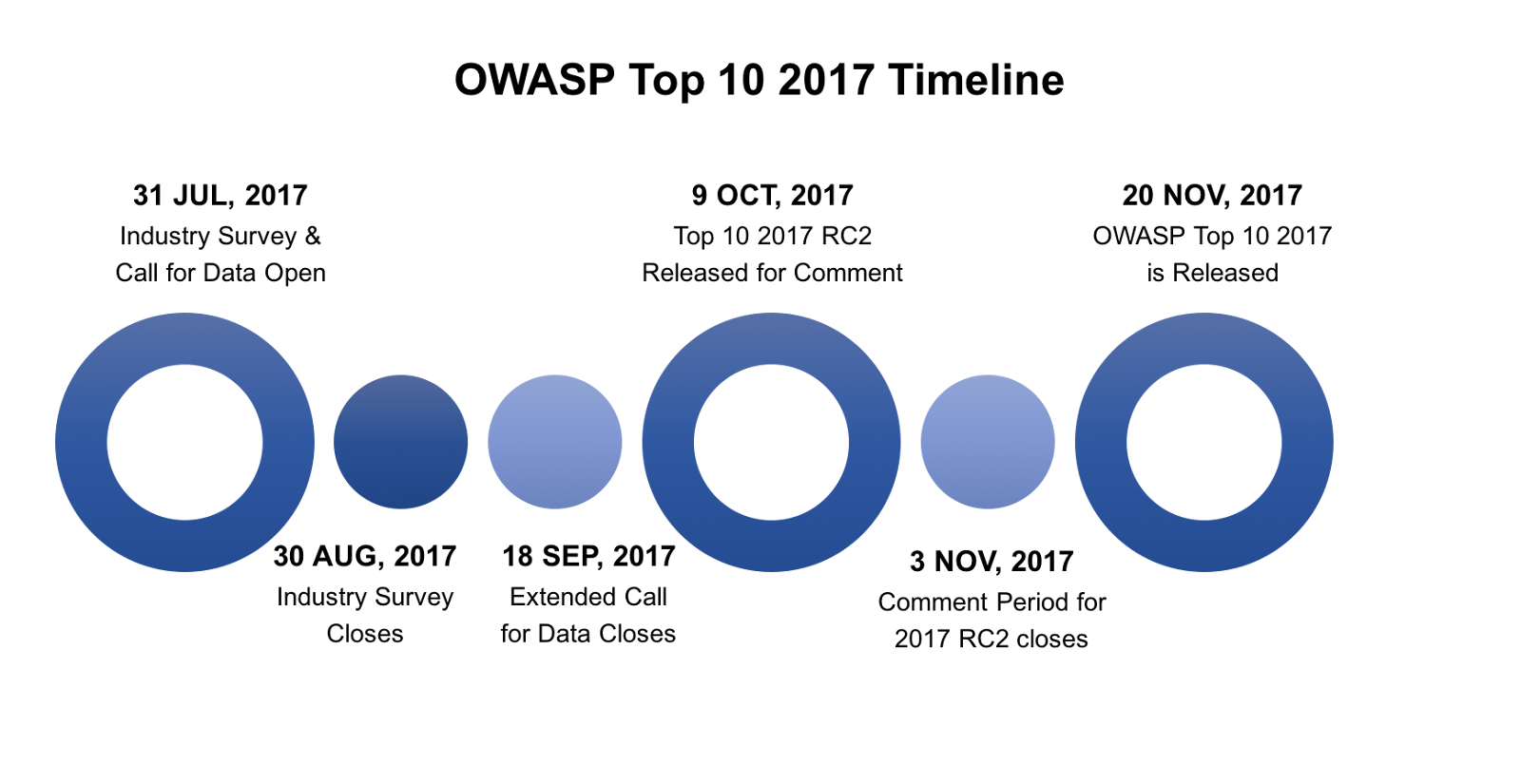
  • For the 2017 Edition, 8 of 10 vulnerabilities will be selected from data submitted via the call for data and 2 of 10 will be selected from an industry-ranked survey.
  • A ranked survey (https://goo.gl/forms/ltbKrdYrp4Qdl7Df2) is now available for industry professionals to select two new vulnerability categories for inclusion in the Top 10 2017. The deadline for the survey is 30 August, 2017.
  • The call for data (https://goo.gl/forms/tLgyvK9O74r7wMkt2) is now reopened to allow for additional data to be collected for analysis. The new deadline for the extended data call is 18 September, 2017.
  • The Top 10 2017 RC2 will released for review and feedback 9 October, 2017.
  • The final release of the Top 10 2017 is targeted for 18 November, 2017.


OWASP Top10 Timeline-v2.png


The OWASP Top 10 has always been about missing controls, flawed controls, or working controls that haven’t been used, which when present are commonly called vulnerabilities. We have traditionally linked the OWASP Top 10 into the Common Weakness Enumeration (CWE) list maintained by NIST / MITRE. We will continue to align with CWEs and utilize the CWSS scoring system to help provide an industry standard measurement.
For the Top 10 2017, we will be focusing on vulnerability categories. These categories will be mapped to one or more CWEs where possible. The scoring system for the Top 10 will be updated to leverage the CWSS as much as feasible. Like the Common Vulnerability Scoring System (CVSS) for specific Common Vulnerabilities & Exposures (CVEs), we are intending to use CWSS for vulnerability categories. In the scenario where there are multiple CWEs, we will use the high-water mark; if there is a vulnerability category without a matching CWE, we will do what we can to align a CWSS score.
Although the OWASP Top 10 is partially data-driven, there is also a need to be forward looking. At the OWASP Summit we agreed that for the 2017 Edition, eight of the Top 10 will be data-driven from the public call for data and two of the Top 10 will be forward looking and driven from a survey of industry professionals. The OWASP Top 10 will clearly identify which items are forward looking: we will use the CWSS score of these items (if a CWE for the issue exists) or our best judgement on where the issue will be ranked in the Top 10.


The extended call for data can be accessed here: https://goo.gl/forms/tLgyvK9O74r7wMkt2
The two items that are not data-driven will be supported by a qualitative survey. The survey is comprised of vulnerability categories that were identified as “on the cusp,” mailing list feedback, and previous call for data feedback. Respondents should rank the top four most important vulnerability categories from their knowledge and experience. The two vulnerability categories with the total highest ranking will be included in the Top 10 2017. The information will also help us develop a plan to better structure the call for data for the OWASP Top 10 2020.


The survey can be accessed here: https://goo.gl/forms/ltbKrdYrp4Qdl7Df2


Every single issue in the OWASP Top 10 should have a direct cause: either one or more missing or ineffective controls, or not using an in place control. Every issue should be precise in its language and view (as in not intermingling the terms “weakness,” “vulnerability,” “threat,” “risk,” or “defect”) so each issue can be theoretically testable. This will help us make a stronger and more defensible list of included items.
We aim to review and resolve ontological concerns, such as including issues that are not like the others. This means that in some circumstances, there should be a view from the Developer perspective (documented by the OWASP Proactive Controls) and a view for the Defending Blue Team (documented by the currently non-existent OWASP Defensive Controls).
Every issue should contain clear and effective advice on remediation, deterrence, delay and detection that can be adopted by any development team - no matter how small or how large. As the OWASP Top 10 are important vulnerability categories, we should strive to make our advice easy to follow and easily translatable into other languages.
From a methodology point of view, we are looking at taking lessons learned from 2017 and coming up with a better process for the OWASP Top 10 in 2020. We would like to coordinate with other teams to provide a staggered release of the other OWASP Top 10 efforts with sufficient time between each release to allow the industry to upgrade and adopt in a practical way.
Lastly, we are opening up the text to provide history and traceability. We need to ensure that all of the issues documented within any of the various Flagship projects, but particularly the OWASP Top 10, can be satisfied by developers and devops engineers without recourse to paid tools or services. There is value in the use of paid services and tools, but as an open (as in free and in liberty) organization, the OWASP Top 10 should have a low barrier of entry, and high effectiveness of any suggested remediations.
Thank you, and we look forward to working with you on the OWASP Top 10.


OWASP Top 10 Project Leaders
Andrew van der Stock
Neil Smithline
Torsten Gigler
Data Analyst

Brian Glas

Labels: , , ,

Wednesday, May 31, 2017

OWASP Threat Dragon Project Update


OWASP Threat Dragon Project
Project: Leader: Mike Goodwin   Github Link

Threat modelling is a very powerful technique for finding and fixing design-level flaws in applications. It is especially good at promoting defence-in-depth. However, the free tooling that is currently available is limited. OWASP Threat Dragon aims to fix that by providing a free, open source threat modelling tool that
  • Is cross-platform
  • Is easy and enjoyable to use
  • Integrates well with other SDLC tools
  • Has a powerful threat generation rule engine
Although Threat Dragon is an Incubator project, it is progressing well and I hope it will be ready to be promoted to Labs soon. Some highlights of the project so far:
  • The original working prototype has been given a major architecture review. This was my first node.js project and my first significant Angular application so there were quite a few kinks to be straightened out. Also, I completely rethought the model storage approach - originally it was using browser local storage like Mozilla SeaSponge, but this turned out to be problematic in practice.
  • A web application variant that uses GitHub as a backend for storing model files. I have plans to add support for BitBucket and possibly other backends soon. This source control system integration is key to the success of the project IMO and I have lots of plans for deeper and better integration in the future.
  • An installable, cross-platform desktop variant based on Electron and using the local file systems for model storage. This is important for people who use a source control system that is not supported by the web app variant, or for people who want to evaluate the tool without giving it access to their repos. The desktop variant shares >85% of it's code with the web app variant - including most of it's UI. This is critical to make it manageable by a small team (just me at the moment!). The desktop app is still a little rough around the edges compared to the web app (e.g. no auto-update on OSX yet) but it is getting there and most of my effort on the project is going into that at the moment.
  • Good unit test coverage (>90%). Quality is not just for Flagship projects - Incubator projects need it too!
  • A cute logo dragon called Cupcakes :o) (based on an original image by DreamsOfMine)
So what's next for Threat Dragon? Well, firstly, although I think it's progressing well on the first 3 key project aims, that's just my opinion. It needs feedback. Lots of feedback. All feedback is welcome - feature requests, bug reports or comments on any aspect of the project. Secondly, at the moment it can be used for basic threat modelling, but the threat generation engine is just a stub. You have to come up with all the threats yourself. Threat generation is the next major functional area that I plan to tackle - hopefully with some collaborators. Thirdly, did I say I was interested in feedback?


Please give it a try and let me know what you think!  

Labels: , , , ,

Thursday, March 30, 2017

OWASP SAMM v1.5 Release

According to recent research published by SANS: 23% of respondents said that applications were the source of actual breach, data loss and attacks on others and only 25% of the respondents believe they have a mature application security program.

The OWASP Software Assurance Maturity Model (SAMM) enables organizations to formulate and implement a strategy for software security that is tailored to organization-specific risks. With SAMM, organizations can accurately evaluate their existing software security practices and steadily improve their security posture over time in well defined iterations designed to meet their unique needs. The SAMM scoring model also helps demonstrate concrete improvements to security related activities throughout an organization. SAMM is one of the very few mature and open resources available to assist organizations measure and build software security programs.

Example SAMM Scorecard
 The new additions to OWASP SAMM are a direct response to the relentless occurrence of security breaches where vulnerable software allowed attackers to gain access to private, corporate data. Bart De Win, co-project leader of OWASP SAMM, says "Our main goal for version 1.5 was to support our large user community by incorporating their feedback and improving the measurement system of the model."

Anyone who has filled out a SAMM assessment has had a discussion on whether to mark an answer “yes” or “no”, when the answer is honestly something in between. By replacing the Yes/No answers with four graduated steps, SAMM v1.5 improves the granularity of scoring, allowing partial credit for achieving maturity benchmarks.This coupled with the matching scoring system, makes it easy to see maturity improvements from projects and initiatives on a dashboard. One of the main benefits of the updated scoring model is that you can visibly see improvement to your maturity score on the dashboard as initiatives are completed. This can go a long way in building support for your Application Security Program.

Example Worksheet

SAMM v1.5 has enhanced explanations of the maturity model with worksheets and guidance containing example case studies which allows organizations not only understand where they are, but to understand what has worked (and hasn't) for others in similar scenarios. This is a continuing effort with more improvements expected in v2.0. Implementing SAMM is easier with a new Quick Start guide and Tool Box that includes interview forms and the ability to generate road maps, charts, and graphs.


For more information you can visit https://www.owasp.org/index.php/SAMM, watch the SAMM v1.5 Webinar on YouTube, or download the slide deck on SlideShare.


Follow OWASP SAMM on twitter. For additional info email owasp.foundation@owasp.org

Labels: , , , ,

Monday, February 6, 2017

OWASP Project Releases


New Release 2/6/17
  • Change Session to no longer call/use ExtensionActiveScan.
  • Change ActiveScanController to obtain the excluded URLs (session and global) instead of having the Session to set them.
  • Change ExtensionActiveScan to allow to set a list of excluded URLs and to not change running active scans, normalizing the behavior with the normal spider.

New Release 1/19/2017 Latest Release Version 1.1.4

Code Pulse 1.1.4 brings along updates to the distributed stack:
  • ASM has been updated to version 5.1 - this enables Java 8 tracing support
  • Java, Jetty, and NW.js have been updated to the latest versions
  • Dependency-Check has been updated to the latest version


New Release 1/30/2017 Latest Release Version v2.21.2

  • The name field of all challenges was changed to a more human- and CTF-friendly form (see #264)

OWASP Off  The Record 4 Java

OWASP Foundation would like to welcome Project Leader Jigar Joshi !

Type of Project: Code Project
Brief Description:
Privacy is daily reality for many internet users. Eavesdropping user's content and using it for various reason is not desired by many of the application users. Putting trust on communication channel, service provider or government not to intercept your content is not a good idea.
OTR framework solves this problem by cryptographically processing the users content in transit and at rest. No eavesdropper can read the content, not even the service provider.

Labels: , , , , , , ,